
image

Our Location

C-36, Maruti Estate, Nr. Kiran Industries,
Phase : I, G.I.D.C. Vatva Ahmedabad GJ-IN 382445

Our Blog


Transformers and Its Impact on Modern Life

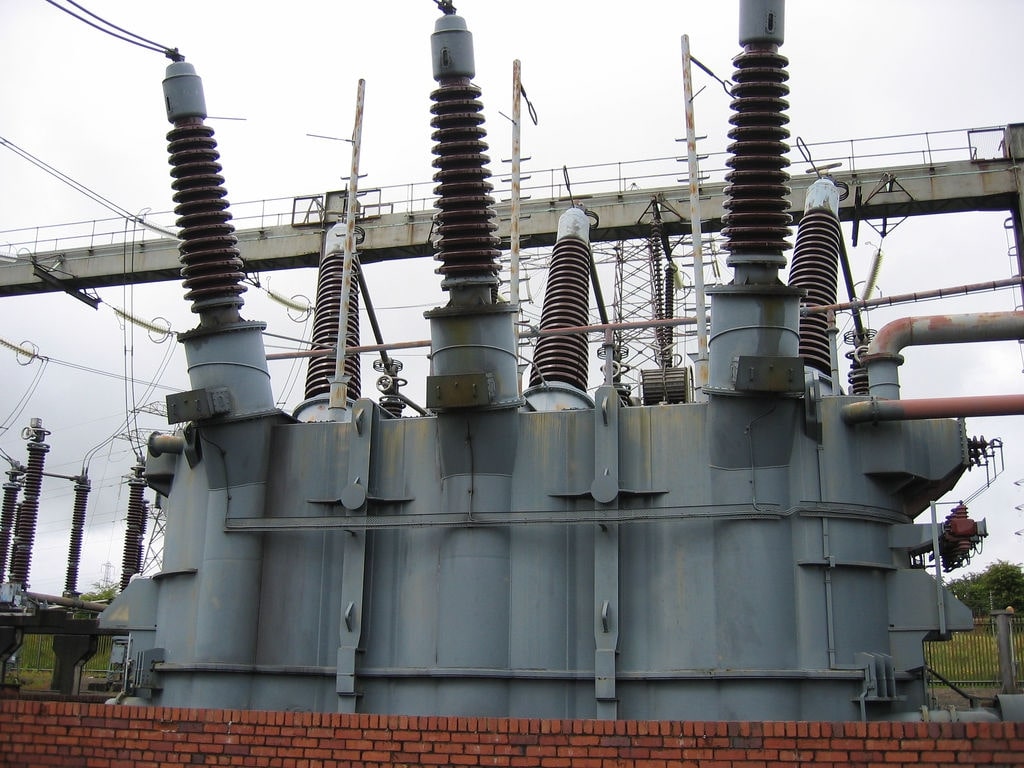
The word transformer is a household name in my village, and it means different things to different people. If my male relative should define it, he would probably say it is a device that quickly breaks down and takes so much time to repair or replace. You can't blame him because we have experienced series of power outages in the past due to transformer breakdown and some lasted up to a year before it was restored.

Responsive image

And when you are from this part of the country you would agree with me that its (quality of being liked a lot or done a lot) has nothing to do with delivering its duties. Its (quality of being liked a lot or done a lot) is due to the frequent breakdown of the transformers with paired-up power outages caused by overloading.

There is hardly a village or community where there is appropriate power system planning. People will build a house and hook it to the nearest electric pole without, the permission of the power utility company. Transformers are rated in KVA, and as such, there is a level of sustained overload it cannot take.And in these areas, the first (or most important) source of the power outage is burnt out transformer coils due to overload.

Many people (who use a product or service) have no records with the utility company, but that does not stop them from using/eating/drinking power. They bring out the services of road-side electricians to connect them illegally to the power system network since there are no smart meters or sensors to signal the utility for such illegal connections. Such is the way the system is loaded without the knowledge of the power company.

Overhead lines can easily be watched/supervised by linesmen to establish when there are illegal tappings. Unfortunately, even when the linesmen command/(have someone write what you say) such stealing, they hardly report it. They take advantage of it by agreeing with such doubtful minds to pocket maybe half of what the guessed (number) bill themselves, (giving less than the correct amount of something) their company. In the end, the utility and the masses will carry the biggest part of such act.

The first power distribution system was invented by Thomas A. Edison in the United States. It was a 120-V dc system designed to supply power for glowing light bulbs. The first central power station built by Edison came into operation in New York City in September 1882.

This system suffered from big power losses because it transmitted power at low voltage and therefore needs/demands high current to be able to transmit a big amount of power. These high currents caused heavy voltage drops and power losses in the transmission lines, hugely limiting the service area of a creating station. To turn away/avoid this heavy power loss, they chose to/chosen to (because there was no other choice) locating the central power stations every few city blocks.

The low-voltage dc power systems could not be used for long-distance transmission because of heavy line losses; this (bad result or effect) resulted in the localization of creating stations. They were mostly inefficient because they were built in a small ability (to hold or do something).

The invention of the transformer and the later development of ac power sources gave birth to high voltage ac transmission with the advantage of (almost nothing/very little) power losses in the transmission lines.

An ideal transformer (lossless) changes one ac voltage level to another voltage level without changing the actual power supplied. If a transformer steps up the voltage level of a circuit, it must hold down and stop the current to maintain that the power into the device equal to the power out of it.

This attribute of the transformer enables ac electric power to be created at one central location; its voltage stepped up by a unit transformer for transmission over long distances at very low losses. When it gets to the low voltage substations, it would be stepped down again depending on the need of the person (who uses a product or service).

The transmission losses in the lines of a power system are (fair in amount, related to/properly sized, related to) the square of the current in the lines, therefore, raising the transmission voltage and reducing the paired-up transmission currents by a factor of 10 with transformers reduces power transmission losses by a factor of l00. Transformer helped and improved the way we use power.

One of the transformer windings is connected to a source of ac electric power, and the second (and perhaps third) transformer winding supplies electric power to loads. The transformer winding connected to the power source is called the primary winding or input winding, and the winding connected to the loads is called the secondary winding or output winding. If there is a third winding on the transformer, it is called the tertiary winding.

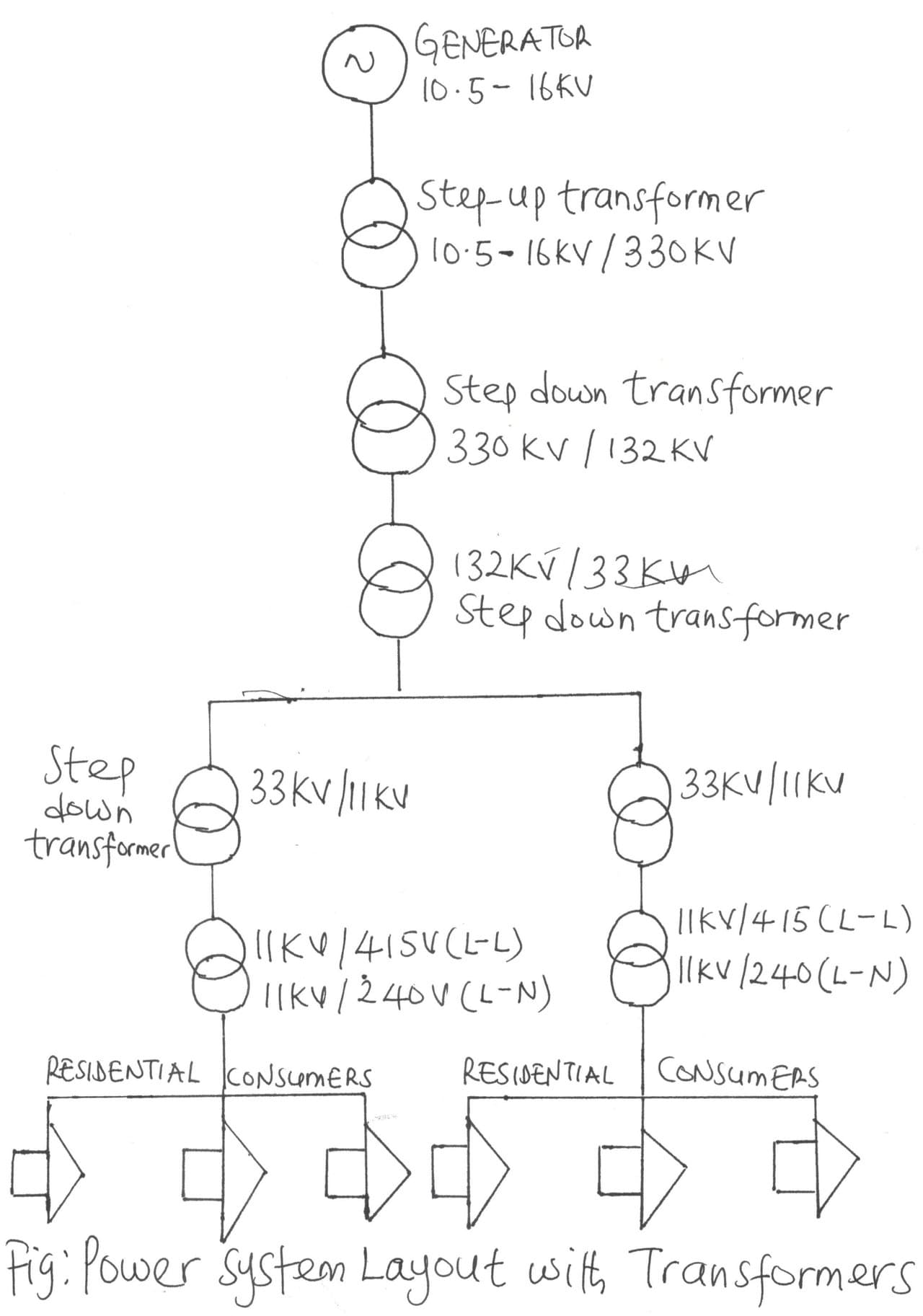
In a modern power system, and in Nigeria precisely, electric power is generated at voltages of 10.5-16KV. The unit step-transformers step up the voltage to 330 kV for transmission over long distances at very low losses. The voltage of 330KV is called primary transmission voltage. There are sub-stations along the line, and it will get to where the voltage will be brought down to 132KV by a step-down transformer. The 132KV is called secondary transmission voltage.

Consider the power system layout diagram below:


Responsive image

The primary distribution commences at the next transformer sub-station where the voltage will be reduced to 33KV.
The voltage is further stepped down to 11Kv, and this is the secondary distribution voltage. Consumers taking large amounts of power up to and above 500KVA may be supplied directly from the secondary distribution network.
The bulk of the consumers are supplied majorly from the tertiary distribution because their load is much smaller.
A typical classification of the different voltage levels along the line of power system in Nigeria is as tabulated:
Primary Transmission 330KV
Secondary Transmission 132KV
Primary Distribution 33KV
Secondary Distribution 11KV
Tertiary Distribution 415L-L; 240 L-N

TYPES OF TRANSFORMERS

The principal purpose of a transformer is to convert ac power at one voltage level to ac power of the same frequency at another voltage level.
Transformers are also used for a variety of other purposes (Instrument transformer which is of two sub-division: voltage transformer and the current transformer, impedance transformation). We will consider every one of these uses the transformer can serve

Purpose of Instrument Transformers

Instrument transformers provide either a current or voltage at a level proportional to the equivalent high voltage or current in a given circuit.

VOLTAGE TRANSFORMER(Potential Transformer)

It is more economical to construct protective equipment at a lower voltage to monitor high voltage lines or equipment than building such equipment at a voltage level equal to the rating of the equipment being protected. The Voltage transformer is used for voltage sampling and can be referred to as potential transformer.